
GET A FREE CONSULTATION
(702) 680-1111

Founding Member & Managing Partner at Gina Corena & Associates
Practice Areas: Personal Injury

Truck accidents in Las Vegas are often serious, involving heavy vehicles, multiple parties, and complex investigations. Unlike minor collisions, these crashes demand detailed documentation to uncover what really happened and who may be at fault. Gathering and preserving truck accident evidence is one of the most important steps after a collision.
This guide explains what kind of evidence after a truck accident is most valuable, how investigators use it to prove fault, and why Nevada laws make quick action so important.
Every truck crash leaves behind a trail of physical, electronic, and human evidence. From police officers at the scene to insurance investigators, several parties collect and analyze this data.
Evidence collection usually begins right at the crash site. Officers document the scene, record statements, and file official reports. Victims and witnesses often take photos or videos before the wreckage is cleared. Later, investigators examine black box data, maintenance records, and company logs.
Acting quickly matters. Many digital records, such as Electronic Logging Device (ELD) data, can be automatically deleted or overwritten within months.
Under Nevada law, police reports must be filed for serious accidents as per NRS §484E.030 and NRS §484E.050, ensuring official documentation exists for every major crash.
Below are the main types of evidence that play a key role in determining fault and supporting a clear, fact-based understanding of the incident.
Police reports are among the most reliable sources of initial information. They contain the accident’s date, time, and location, along with weather conditions, damage estimates, and witness statements. Because they’re prepared by a neutral party, these reports often become the foundation of the investigation.
Injuries from truck accidents are often severe due to the vehicle’s size and force. Medical records show how the injury occurred, the type of treatment received, and its long-term impact. Keeping these records helps prove that the injuries were directly linked to the crash.
Witnesses can provide valuable insights that aren’t always visible in police reports. Someone nearby might have noticed the truck speeding, swerving, or running a red light moments before the collision. Their observations help confirm or challenge other pieces of evidence.
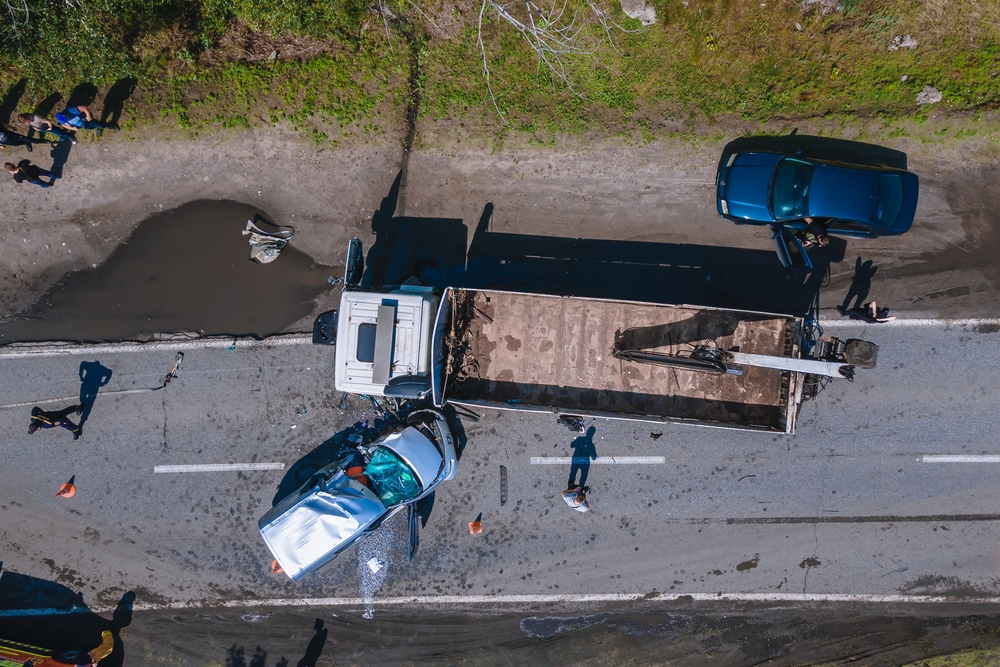
Visual documentation tells the story that words sometimes cannot. Photos of vehicle positions, skid marks, or debris patterns help investigators recreate the crash sequence. Even short videos from dashcams or surveillance cameras can reveal critical details about driver behavior or lighting conditions.
Federal law requires commercial trucks to use ELDs, as outlined in FMCSA §395.8. These devices record the driver’s hours of service, speed, rest breaks, and engine activity. If a driver was fatigued or violated rest regulations, ELD data can uncover that pattern.
Black box data adds another layer by capturing sudden braking, acceleration, and engine performance moments before impact. Together, they help investigators understand whether driver error or mechanical failure played a role.

Federal law under 49 CFR §396 requires trucking companies to perform regular inspections and maintenance. Poorly maintained brakes or tires often contribute to crashes. Maintenance logs can reveal whether the company ignored known issues, failed inspections, or pushed vehicles beyond safe limits.
In Nevada, proving negligence means showing that someone failed to act with reasonable care, directly causing harm. Evidence from police reports, ELD data, and maintenance logs helps determine this.
Common examples of negligence include:
Under NRS §41.141, Nevada follows the comparative negligence rule, which means fault is shared among parties. If a victim is found to be less than 50% responsible, they can still recover damages, but their recovery is reduced by their percentage of fault.
Multiple parties can share liability in a truck crash: the driver, trucking company, parts manufacturer, or cargo loader. Each piece of evidence helps clarify who contributed to the accident and to what extent.
One of the biggest issues in truck accident cases is evidence loss. Delays can result in missing footage, deleted digital logs, or misplaced records. Sometimes, critical data is intentionally or accidentally destroyed known legally as spoliation of evidence.
To prevent this, victims should:
“Photographic and digital evidence collected within hours of the crash holds the highest reliability during litigation or insurance review.”
Taking action early gives investigators a clearer picture of what truly happened.
Truck accident investigations rely on both federal and state laws to determine liability.
Understanding how these systems work together allows victims and investigators to approach cases with clarity and precision.
“According to the Federal Motor Carrier Safety Administration (FMCSA), driver fatigue contributes to nearly 13% of all large-truck crashes in the United States.”
|
Evidence Type |
Source |
What It Proves |
Related Regulation |
| Police Report | Law enforcement | Basic facts, preliminary fault | NRS §484E.030 |
| Medical Records | Healthcare providers | Injury severity and causation | — |
| ELD / Black Box Data | Trucking company | Driver hours, speed, fatigue | FMCSA §395.8 |
| Maintenance Logs | Fleet operator | Negligent maintenance | 49 CFR §396 |
| Photos & Videos | Victims / witnesses | Scene conditions, damage, injuries | — |
| Witness Statements | Bystanders | Behavior before impact | — |
Evidence shows how and why a crash happened, helping investigators determine responsibility under federal and Nevada state law.
Keep every document and digital record for at least two years, matching Nevada’s statute of limitations.
They show driving hours, speed, braking, and rest periods, helping prove fatigue or violations.
Yes. Drivers, companies, and maintenance providers may all share responsibility depending on evidence.
Request police reports, photograph the scene, collect contact details, and store digital data securely.
Every truck accident case in Las Vegas depends on the strength of the evidence behind it. From police reports and ELD logs to medical records and witness statements, each document tells part of the story. The sooner that evidence is gathered and preserved, the clearer the picture becomes for determining what went wrong.
If you or someone you know has been involved in a truck accident, understanding what evidence matters most can make all the difference. Gina Corena & Associates has deep experience helping victims navigate Nevada’s complex trucking laws and ensuring critical proof is protected.
Reach out today for a free consultation to learn how the firm can guide you through the process and help you understand your legal options.

As founder of Gina Corena & Associates, she is dedicated to fighting for the rights of the people who suffer life-changing personal injuries in car, truck and motorcycle accidents as well as other types of personal injury. Gina feels fortunate to serve the Nevada community and hold wrongdoers accountable for their harm to her clients.