
GET A FREE CONSULTATION
(702) 680-1111
When a death is caused by negligence, families are left dealing with grief and immediate financial pressure at the same time. We handle the legal process so you don’t have to carry both.
Schedule your free consultation
In a wrongful death case, everything comes down to one thing: proving who caused the loss. Because the person at the center of the case can’t speak, the evidence has to do all the work. That makes our work in the first weeks especially important.
We gather the proof while it still exists, including police or incident reports, scene evidence, medical and employment records, and accounts from anyone who witnessed what happened. In many cases, there are two claims involved: a wrongful death claim for the family and a survival claim for the estate, and both have to be supported with their own evidence.
We also stand between the family and the insurance company. After a fatal accident, when an insurer pressures a grieving family to settle, it is a real risk, so we take those calls. We explain how Las Vegas wrongful death claims work at a pace that respects what the family is going through.
There is no cost to start. We work on a contingency fee, which means the family owes nothing unless we recover compensation.
$1,040,000
$1,023,006.92
$1,010,000
$1,010,000
A wrongful death claim can arise from any situation where someone’s negligence or wrongful act leads to a fatal outcome. The circumstances vary, but the core question stays the same: Did someone act carelessly in a way that caused a death that could have been prevented?
These cases often overlap with other serious injury matters, like vehicle crashes, medical negligence, or workplace incidents. That overlap matters because it shapes how evidence is gathered and which experts may be needed to understand what went wrong.
The wrongful death cases our Las Vegas attorneys see most often arise from:
Whatever the cause, the first task is the same. We identify every party whose negligence contributed, because each one may share responsibility for the family’s loss.

Nevada law is specific about who may bring a wrongful death claim and allows two types of claimants. The decedent’s heirs may sue for their own loss, and the personal representative of the decedent’s estate may sue on the estate’s behalf (NRS 41.085). The two claims are usually filed together.
“Heirs” are not unlimited. Nevada follows a set order of succession, typically starting with a surviving spouse or domestic partner, then children, then parents, and then siblings. Anyone who caused the death cannot benefit from the claim or recover from it.
Getting this right at the start matters. Nevada courts generally expect all eligible parties to bring a single, unified claim rather than separate lawsuits. If the case is filed incorrectly or in pieces, parts of the claim can be lost. That’s why identifying standing early is such an important first step.

Nevada splits a wrongful death recovery into two parts because the law recognizes two claimants. One claim belongs to the heirs, and one belongs to the estate. They cover different losses.
Heirs’ recovery is generally protected from the decedent’s personal debts, while any recovery that belongs to the estate passes through the estate process. In most Nevada wrongful death cases, damages are not capped. However, there are key exceptions. Medical malpractice cases are subject to Nevada’s noneconomic damages cap, and claims involving government entities are also capped, with Nevada applying that cap separately to each heir’s claim rather than as a single shared limit.
The final recovery can also be reduced by comparative fault. If a jury values a claim at $2,000,000 and finds the decedent 25% at fault, the award is reduced to $1,500,000. Under NRS 41.141, recovery is barred entirely only if the decedent is found more at fault than the defendant. In cases involving reckless conduct such as drunk driving, punitive damages may also be available under NRS 42.005.

Gina Corena & Associates focuses on serious injury and wrongful death cases across Las Vegas and Clark County courts. Our team has recovered seven-figure results in a wide range of complex claims, and we understand how these cases are handled from filing through trial.
A wrongful death case isn’t just legal work; it’s also timing, paperwork, and pressure from insurance companies. We handle the two claims, the estate process, and insurer communication so families aren’t forced into early decisions while they’re still grieving.
Clients also have direct access to their attorney. Founding attorney Gina M. Corena, recognized by the American Society of Legal Advocates and listed among the Top 40 Under 40 and Ten Best Attorneys in Nevada, built the firm on that approach. Cases are handled on a contingency fee basis, meaning there is no cost unless we recover compensation.



Fatal accidents are a constant in Nevada. The state recorded about 419 traffic-related deaths in 2024, with roughly 293 in Clark County alone (Nevada Office of Traffic Safety, 2026). Traffic crashes are only one source. Wrongful death claims also follow medical mistakes, defective products, unsafe properties, and workplace incidents.
Behind each of those numbers is a family. Nevada law gives the family a way to hold the responsible party accountable, and Nevada fatal crash data shows how often that path is needed.
A wrongful death case cannot undo the loss. What it can do is cover the financial weight the loss leaves behind and require the party at fault to answer for it.
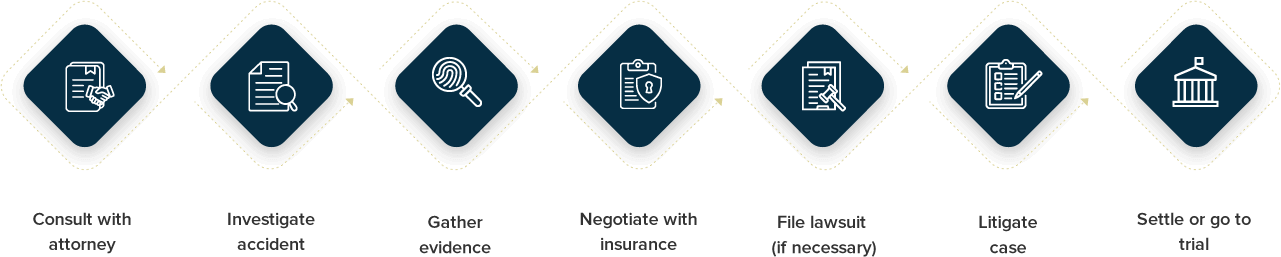
We begin with a detailed consultation to understand what happened and identify who has the legal right to bring the claim under Nevada law. This includes reviewing police reports, medical records, initial evidence, and confirming the proper heirs and estate structure so the case is filed correctly from the start.
Next comes the investigation. We move quickly to preserve evidence like witness statements, scene documentation, medical records, employment information, and any available digital or video footage. At the same time, we evaluate liability and the full financial and emotional impact of the loss, including both the estate’s claim and the family’s individual claims.
If the insurer doesn’t offer fair compensation, we file a lawsuit and move the case through litigation toward settlement or trial.

The experience of our attorneys ranges from insurance and commercial law to personal injury and other areas which give our team an unmatched ability to reach a favorable outcome in your case. We handle each matter with accountability and responsiveness, as if we were representing ourselves.
A wrongful death claim is a civil case brought when someone dies because of another party’s wrongful act or negligence. It is separate from any criminal case, and it lets the family recover for the financial and personal loss the death caused.
Two parties. The decedent’s heirs, in the order Nevada law sets, can file for their own loss, and the personal representative of the estate can file on the estate’s behalf. Nevada expects a single, joined case.
You generally have two years from the date of death to file a wrongful death claim under NRS 11.190. If a government agency is involved, a separate written notice may also be required within that same timeframe.
Heirs may recover damages for grief, loss of companionship, and loss of financial support. The estate may recover medical expenses, funeral costs, and any losses tied to the decedent’s injuries before death. In cases involving especially reckless or intentional conduct, punitive damages may also be available. Most wrongful death damages in Nevada are not capped.
No. A criminal case is brought by the state and may result in punishment. A wrongful death claim is a civil case brought by the family for compensation. A family can pursue the civil claim even if there is no criminal charge or conviction.
A family can still recover. Nevada reduces the award by the share of fault assigned to the person who died, and bars recovery only if that person was found more at fault than the defendant.
Nothing upfront. We work on a contingency fee, so the family pays only if we recover compensation, and the first consultation is always free.

Founding attorney Gina M. Corena has been named a Top 40 Under 40 attorney by the American Society of Legal Advocates and one of the Ten Best Attorneys in Nevada.