
GET A FREE CONSULTATION
(702) 680-1111
After a commercial truck crash, the trucking insurer builds its defense within hours, and the results we have recovered for injured clients show why moving first matters.
Schedule your free consultation
A truck accident is a different kind of case from a car crash. A loaded tractor-trailer can weigh 20 to 30 times what your vehicle does, and the company behind it answers to a federal rulebook ordinary drivers never touch. That gap decides how the case gets built.
Much of the proof lives in the truck’s own records. Electronic logging data, inspection reports, and dashcam footage all tell the story, and the essential evidence in a truck accident claim is often electronic. Federal rules require carriers to keep those electronic logs for only six months (FMCSA), so the evidence that wins your case can disappear before a lawsuit is ever filed.
Our first move is a preservation letter that legally orders the trucking company to hold its logs, black-box data, and maintenance files. Then we investigate the carrier (the dispatch records and the hiring file often matter more than the police report), not only the driver.
There is no cost to start. We work on a contingency fee, which means you owe nothing unless we recover compensation for you.
$1,040,000
$1,023,006.92
$1,010,000
$1,010,000
Most Las Vegas truck crashes trace back to a violation of a specific federal safety rule. The Federal Motor Carrier Safety Administration regulates how long drivers can work, how cargo must be secured, and how trucks have to be maintained. When a carrier cuts a corner on one of those rules, people get hurt.
Driver fatigue is the rule broken most often. Federal hours-of-service limits cap a trucker at 11 hours of driving and require a 30-minute break after 8 hours behind the wheel (FMCSA). A dispatcher pushing a tight delivery window is a common reason those limits get ignored.
The crashes our Las Vegas truck accident lawyers see most often involve:
Each of those causes leaves a paper trail. Hours-of-service violations show up in electronic logs, cargo problems appear in loading manifests, and a skipped repair is written into an inspection report the carrier hoped no one would ask for.
Naming the cause is how our attorneys find every party whose negligence put that truck on the road.

More than one party is usually responsible for a truck crash. The driver may have been negligent, and the motor carrier that employed and dispatched that driver is liable too. Under a rule called respondeat superior, an employer answers for an employee’s on-the-job negligence.
Liability can also reach the company that loaded the cargo, the contractor that serviced the truck, the freight broker that hired an unsafe carrier, or a parts manufacturer. A 2024 Nevada Supreme Court decision, Malco Enterprises v. Woldeyohannes, even kept the door open to holding a rental company responsible. Knowing how the trucking company will defend the claim shapes how we name defendants from the start.
Identifying every responsible party is not academic. Each defendant carries its own insurance policy, so the more parties our attorneys can hold accountable through proving responsibility in a trucking accident, the more coverage exists to pay for a catastrophic injury.
A truck accident claim can recover the full economic cost of your injury. That covers past and future medical treatment, the income you lost while unable to work, and your reduced earning capacity if the injury is permanent. Nevada does not cap these economic damages, so the figure is tied to the real cost of what happened to you.
You can also recover non-economic damages for pain, suffering, and lost quality of life. One Nevada rule shapes that figure. Under the state’s modified comparative negligence law (NRS 41.141), your recovery drops by your percentage of fault, and once you are more at fault than the other side, it disappears.
Here is what that looks like in practice. If a jury values your case at $400,000 and finds you 20% at fault, you collect $320,000; cross 51% and you recover nothing. When a carrier’s conduct is especially reckless, Nevada also allows punitive damages on top of your compensation (NRS 42.005).
Federal law requires only $750,000 in liability coverage for many freight trucks (FMCSA), a figure set in 1980 that often falls short of a catastrophic injury. We pursue every available policy, which is part of why Nevada truck accident settlements frequently involve more than one insurer.
Gina Corena & Associates focuses on serious injury cases. Our team knows the Clark County courts where Las Vegas truck claims are filed and tried, and we have recovered seven-figure results for injured clients across crash types, including truck accidents.
Truck cases turn on the federal rulebook, and that is where our preparation goes. We read the electronic logs, the inspection reports, and the driver qualification file the way the carrier’s own safety officer would. The trucking company’s lawyers (often working from a claims center in another state, on a settlement playbook) expect that level of scrutiny from very few firms.
You also get direct access to your attorney. Founding attorney Gina M. Corena built the firm on that promise. A Top 40 Under 40 honoree named by the American Society of Legal Advocates. One of the Ten Best Attorneys in Nevada. Every case is handled on a contingency fee, so there is no cost unless we win.

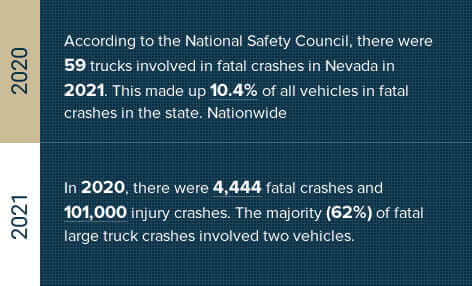
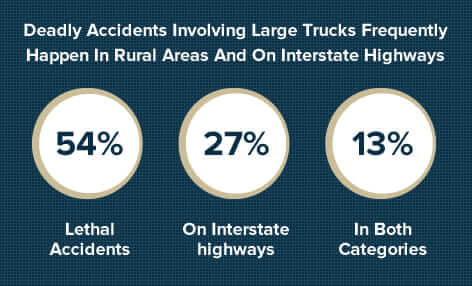
Large trucks are a small share of the vehicles on the road and a large share of the harm. Fatal crashes involving large trucks and buses rose 26.4% from 2016 to 2022, and in 2021 alone, 5,788 people were killed in crashes involving at least one large truck (FMCSA). That was 13.5% of every traffic death in the country. The physics are simple, and they are not on the side of the smaller vehicle.
Fatigue is a quieter cause, and a measurable one. OSHA, citing federal research, reports that being awake for 17 hours impairs a driver about as much as a 0.05 blood alcohol content, and 24 hours awake is closer to 0.10 (OSHA). A trucker who skipped a required rest break is, by that measure, driving impaired.
Locally, the trend has improved. Clark County recorded 239 traffic deaths in 2025, down from 296 the year before. A single truck crash still changes a family’s life, which is why the federal rules exist.

Why move so fast? Because the truck’s electronic logs can be erased in six months and the carrier’s investigators often reach the scene within hours. Our first job is locking down the evidence before it is gone.
From there we build the demand, negotiate with every insurer involved, and file suit if the offer falls short. Nevada gives you two years from the date of injury to file a truck accident lawsuit (NRS 11.190), and missing that deadline ends the claim no matter how strong it was.
Most cases resolve in a settlement. We still prepare each one for trial, and understanding why truck accident claims take longer sets honest expectations. Carriers tend to settle fairly when they see a firm ready to try the case.

The experience of our attorneys ranges from insurance and commercial law to personal injury and other areas which give our team an unmatched ability to reach a favorable outcome in your case. We handle each matter with accountability and responsiveness, as if we were representing ourselves.
Truck cases involve federal safety regulations, commercial insurance, and a motor carrier with its own legal team. The evidence and the number of potentially liable parties are both larger than a typical car claim.
Often the driver and the trucking company, and sometimes the cargo loader, a maintenance contractor, a freight broker, or a parts manufacturer. We identify every responsible party during the investigation.
Two years from the date of injury under NRS 11.190. Wrongful death claims also run two years, measured from the date of death. Key evidence can vanish well before then.
You can still recover, as long as you are not more at fault than the other parties. Your compensation is reduced by your percentage of fault under Nevada’s comparative negligence law.
Many interstate freight carriers must carry at least $750,000 in liability coverage under federal law, and large or hazmat carriers carry far more. Catastrophic cases often need every available policy.
Electronic logging data, inspection reports, and dashcam footage. Carriers keep some electronic logs for only six months, so a legal preservation letter has to go out quickly.
Nothing upfront. We work on a contingency fee, so you pay only if we recover compensation for you, and the first consultation is always free.

Founding attorney Gina M. Corena has been named a Top 40 Under 40 attorney by the American Society of Legal Advocates and one of the Ten Best Attorneys in Nevada.
“Top 40 Under 40” attorney by the American Society of Legal Advocates
“Ten Best Attorneys” in Nevada