
GET A FREE CONSULTATION
(702) 680-1111
A failure to yield can happen in a split second, but the impact can leave you dealing with serious injuries and uncertainty about what happens next. A Las Vegas failure to yield attorney at Gina Corena & Associates can help prove fault and fight for what you’re owed.
Get a Free Case Review
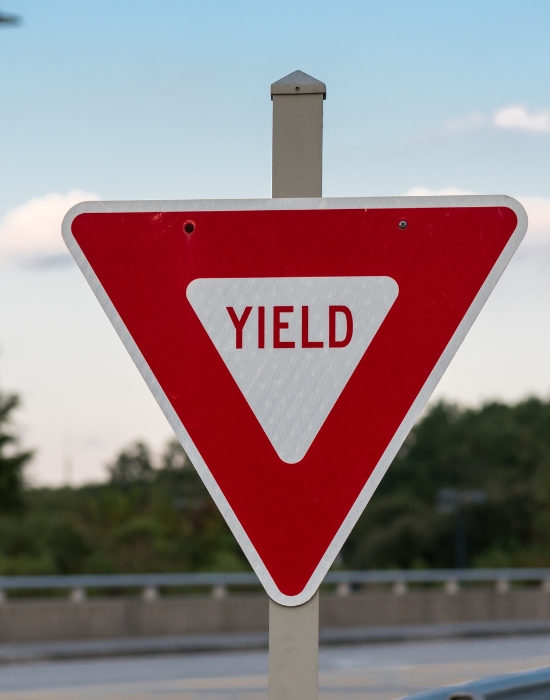
Most yield crashes come down to one simple question: who had the right of way. Nevada law lays this out in NRS 484B.250 through NRS 484B.270, covering intersections, turns, merges, stop signs, yield signs, and crosswalks.
One of the most common situations is a left turn. Under NRS 484B.253, a driver turning left must yield to oncoming traffic that is close enough to be a hazard. The same rule applies when a driver is entering a roadway from a driveway or side street, or when they are crossing an intersection with traffic already moving.
Drivers also have to yield to pedestrians in marked crosswalks and follow posted signs at intersections. These aren’t suggestions. They’re legal duties meant to prevent exactly the kinds of crashes that happen in busy traffic areas.
When a driver ignores these rules and causes a crash, that violation becomes strong evidence of fault and can play a major role in your injury claim.
$1,040,000
$1,023,006.92
$1,010,000
$1,010,000
Failure-to-yield crashes usually follow a few predictable patterns. A driver turns left across oncoming traffic without enough space. Someone rolls through a stop sign or pulls out of a side street without checking properly. A car merges into your lane without matching speed. Sometimes it’s a right turn on red where a driver moves forward without seeing a pedestrian already crossing.
These situations don’t give much time to react. That’s why they tend to end in angled or direct impacts instead of light contact. Even at lower speeds, that kind of force can lead to whiplash, broken bones, or injuries to the head, neck, and spine.
In most cases, the driver who failed to yield is considered at fault, especially when the crash violates traffic rules and right-of-way laws.
Right-of-way crashes usually turn into two different versions of the same moment, which is why evidence matters more than anything else. We start with the basics: police reports, available traffic or surveillance footage, and witnesses who actually saw how the crash unfolded.
From there, we look at the details that don’t always show up in early reports. That can include vehicle positions, timing, and impact points. When needed, accident reconstruction experts step in to break it down and show how the crash likely happened in real terms, not just descriptions.
Because Gina Corena has worked in insurance defense, we also understand how insurers try to challenge liability or blur responsibility in these cases. That experience helps us anticipate their arguments early and build a clearer, better-supported account of events from the start.

Insurance companies often look for ways to reduce what they pay, including arguing that you could have avoided the crash or that you share responsibility. A failure-to-yield attorney helps challenge that version of events by focusing on the evidence. We review the right-of-way rules, investigate the circumstances of the collision, and work to show what actually happened.
Nevada follows a modified comparative negligence rule under NRS 41.141, which means you can still recover damages as long as you are 50% or less at fault, with your compensation reduced by your share of responsibility. Most personal injury claims also have a two-year deadline under NRS 11.190, making it important to understand your options early.
For a broader look at how we handle crash claims across Las Vegas, you can also speak with our Las Vegas car accident lawyer team.

Before founding Gina Corena & Associates, Gina Corena worked in insurance defense, representing insurance companies and creditors. That experience gave her a clear view of how claims are evaluated and how insurers work to reduce payouts. She now uses that background to represent injured people across Las Vegas.
When you work with our firm, you get a team available 24/7 in English and Spanish. We’ve recovered millions of dollars for injured clients across Nevada. We work on a contingency fee basis, which means you don’t pay attorney fees unless we recover money for you.
Call Gina Corena & Associates for a free, no-pressure case review.



Las Vegas sees a high number of traffic crashes every year, and most of them don’t end up being just “car damage” situations. Clark County also accounts for the majority of Nevada’s collisions, especially in dense traffic areas where small mistakes turn into rear-ends, intersection hits, and fender benders.
Statewide data keeps pointing back to the same causes, such as speeding, distracted driving, and following too closely.
It’s not just high-speed highway crashes either. A large share of injury claims in Nevada actually start with lower-speed impacts that still leave people dealing with pain, treatment, and insurance pressure afterward.
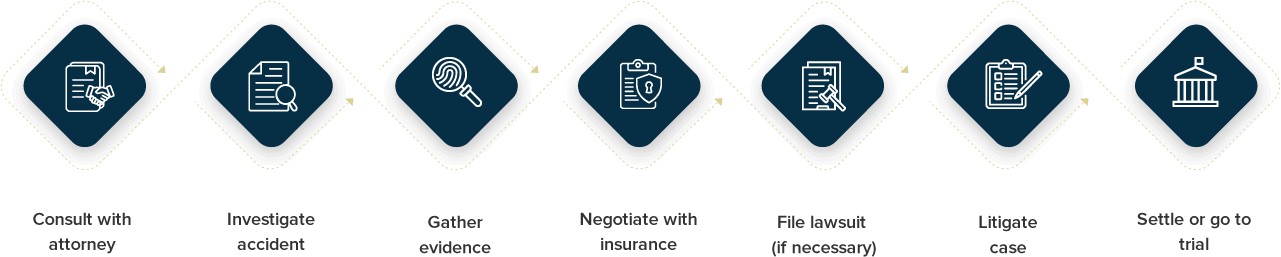
A car accident claim in Nevada usually builds step by step rather than moving in a straight line. It starts with understanding what happened, then quickly shifts into collecting evidence before anything gets lost or overwritten. From there, the focus moves to your medical treatment and how your injuries develop over time, not just the first diagnosis.
Once the full picture is documented, the case moves into negotiation with the insurance company. Most claims resolve here, but if they don’t, the case is already structured to move toward trial without starting over.

The experience of our attorneys ranges from insurance and commercial law to personal injury and other areas which give our team an unmatched ability to reach a favorable outcome in your case. We handle each matter with accountability and responsiveness, as if we were representing ourselves.
Usually the driver who failed to yield the right of way. Nevada’s right-of-way rules (NRS 484B.250 to 484B.270) and the left-turn statute (NRS 484B.253) help establish who was supposed to yield.
Insurers often raise this to shift blame. Under NRS 41.141, you can still recover as long as you are 50% or less at fault, and we use evidence to keep the fault where it belongs.
Generally, you have two years from the date of the crash under NRS 11.190. Waiting too long can limit your ability to bring a claim, even if the case itself is strong.
Often yes. Drivers are required to yield to pedestrians in marked crosswalks, and when they fail to do so, they can be held responsible for the resulting injuries.
There are no upfront fees. We work on a contingency fee basis, which means you only pay attorney fees if we recover compensation for you. The consultation is free.

Gina Corena is a Las Vegas personal injury attorney and former insurance-defense lawyer who has recovered millions of dollars for injured Nevadans.
“Top 40 Under 40” attorney by the American Society of Legal Advocates
“Ten Best Attorneys” in Nevada