GET A FREE CONSULTATION
(702) 680-1111

Founding Member & Managing Partner at Gina Corena & Associates
Practice Areas: Personal Injury
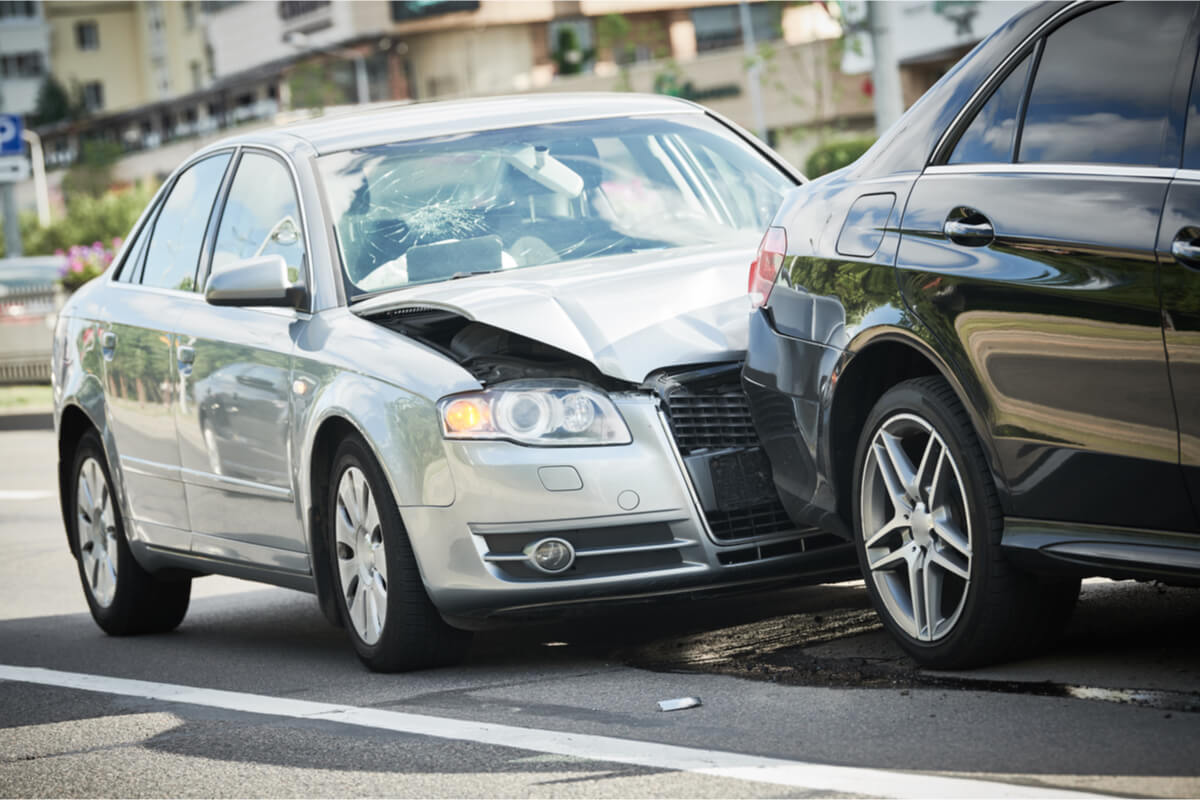
Not all crashes are the same. A light tap from behind at a red light is a very different event from a head-on collision on the highway, and the injuries, the fault question, and the value of a claim all change with the type of collision.
If you were hurt on a Las Vegas road, knowing what kind of crash you were in helps you understand what comes next. The way two vehicles meet often tells a story about who was careless and who was just in the wrong place at the wrong time. When the injuries are serious, or the insurance company starts disputing how it happened, a good first step is to talk with a car crash attorney in Las Vegas who can look at the facts and tell you where you stand.
This guide breaks down the common types of car accidents we see in and around Las Vegas, the injuries each one tends to cause, and how Nevada law decides who is responsible.
The most common types of car accidents are rear-end collisions, side-impact (T-bone) crashes, head-on collisions, sideswipes, single-vehicle accidents, multi-vehicle pileups, and rollovers.
Each type has its own typical cause and injury pattern, and each is treated a little differently once you start proving fault. Rear-end crashes are the most frequent, while head-on and rollover crashes tend to cause the most serious harm. Below, we look at each one in turn.
A rear-end collision happens when one vehicle strikes the back of another. These are the most common crashes on the road. The National Highway Traffic Safety Administration reports that rear-end collisions make up roughly 29% of all traffic accidents, and busy stop-and-go corridors like I-15, the 215, and Las Vegas Boulevard see plenty of them.
Most rear-end crashes come down to a driver who wasn’t paying attention or wasn’t leaving enough room. Texting, tailgating, and speeding are the usual culprits. Even at low speed, the sudden jolt can cause whiplash, neck strain, and back injuries that may not feel serious until a day or two later.
The rear driver is usually presumed at fault because every driver must maintain a safe following distance. That presumption is not absolute, though. If the front driver suddenly reversed or had broken brake lights, the fault can shift. You can read more about who is at fault in a rear-end collision and how that presumption works.

A side-impact crash, often called a T-bone, happens when the front of one vehicle hits the side of another, forming a “T.” These crashes are common at intersections, especially when a driver runs a red light or fails to yield while turning.
T-bone crashes can be dangerous because the side of a car offers far less protection than the front or back. Occupants on the struck side are close to the point of impact, which can lead to broken ribs, internal injuries, head trauma, and spinal damage.
Fault usually turns on who had the right of way. The driver who ran the light, rolled a stop sign, or turned across traffic is often responsible. The way the damage lines up on each vehicle can help show how the crash happened and who entered the intersection unsafely.
To understand the harm these crashes cause, see our overview of the effects of a T-bone accident.
A head-on collision occurs when the fronts of two vehicles collide. These are among the most deadly crashes because the force of both vehicles combines at the point of impact.
Head-on crashes often involve a driver who crossed the center line, drove the wrong way on a divided road or highway ramp, or drifted out of their lane. Impaired driving, drowsy driving, and distraction are frequent factors. The injuries tend to be severe and can include traumatic brain injuries, spinal cord damage, broken bones, and internal trauma.
Because the consequences are so serious, these cases often involve large medical bills and long recoveries. Our guide to common head-on collision injuries covers what victims and families often face.
A sideswipe happens when the sides of two vehicles traveling in the same or opposite directions make contact. These crashes are common during unsafe lane changes, merging, and drifting on multi-lane roads and freeways.
A minor sideswipe might leave only scraped paint. But a sideswipe at highway speed can send a driver fishtailing into another lane, a barrier, or another vehicle, turning one mistake into a chain of impacts. Fault usually rests with the driver who left their lane without checking that it was clear.
A single-vehicle accident involves only one car, such as hitting a guardrail, a pole, a curb, or running off the road. Many are caused by speeding, distraction, fatigue, or poor weather, but not all are the driver’s fault.
Sometimes another party shares the blame. A defective tire that blows out, a part that fails, a poorly maintained road, or a phantom driver who ran you off the road without making contact can all play a part.
In those situations, you may have a claim against a manufacturer, a government entity, or your own uninsured motorist coverage. It is worth having someone look closely before assuming you have no case.
A multi-vehicle crash involves three or more cars, often in a chain reaction where one impact pushes vehicles into one another. These pileups occur in heavy traffic, at busy interchanges, and in low-visibility conditions such as dust or sun glare.
These cases are more complex because more than one driver may share fault, and several insurance companies may be involved. Sorting out who started the chain and how the blame is divided takes careful investigation.
We explain how this works in our guide to chain-reaction collision fault and how to prove liability in multi-vehicle accidents.
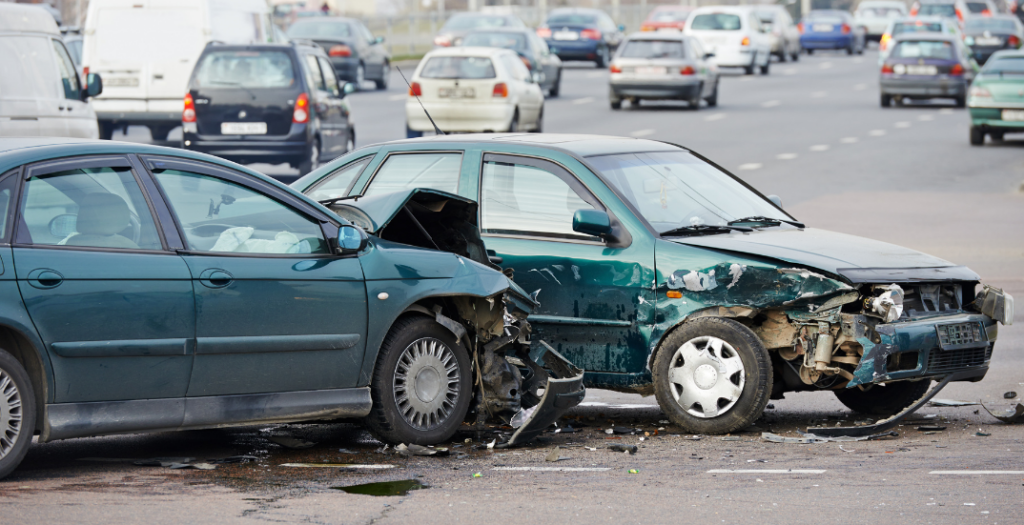
A rollover happens when a vehicle tips onto its side or roof. Taller vehicles, such as SUVs and trucks, are more prone to rolling, especially during sharp turns at speed. Rollovers can also be triggered by another vehicle, a tire failure, or a roadside hazard.
These crashes are violent. Occupants can suffer head and spinal injuries, broken bones, and crush injuries, and the risk is higher for anyone not wearing a seat belt. Because rollovers can involve vehicle design or tire defects, the cause is not always obvious from the scene.
Nevada is an at-fault, or tort, state. That means the driver who caused the crash and their insurance company are responsible for the resulting harm. To recover compensation, you generally need to show that the other driver was negligent and that their negligence caused your injuries.
Nevada also uses a rule called modified comparative negligence (NRS 41.141). You can still recover money even if you were partly to blame, as long as you were not more than 50% at fault. Your compensation is reduced by your share of fault, and at 51% or more, you recover nothing. This is exactly why insurers try to shift part of the blame onto you, no matter what type of crash you were in.
Keep in mind that Nevada generally gives you two years from the date of the crash to file a personal-injury lawsuit (NRS 11.190). Confirming your deadline early protects your right to recover.
Rear-end collisions are the most common. The National Highway Traffic Safety Administration reports that they account for roughly 29% of all crashes. They happen most often in stop-and-go traffic when a driver is following too closely or distracted, and they frequently cause whiplash and back injuries.
Head-on collisions and rollover crashes tend to cause the most severe injuries because of the forces involved. Side-impact (T-bone) crashes are also dangerous since the side of a vehicle offers less protection. These collisions are more likely to result in brain, spinal, and internal injuries.
Yes. The type of collision often indicates how it happened and who was at fault. A rear driver is usually presumed at fault in a rear-end crash, while a T-bone often comes down to who ran the light or failed to yield. Evidence like the police report, photos, and damage patterns helps confirm the story.
Yes, as long as you were not more than 50% at fault. Under Nevada’s modified comparative negligence rule, your compensation is reduced by your percentage of fault. If you are found 51% or more at fault, you cannot recover.
Call 911, get medical care even if you feel fine, and document the scene with photos and witness information. Be careful about discussing fault with the insurance company, and consider speaking with a lawyer before giving a recorded statement. A free consultation can tell you what your claim may be worth.
No matter what kind of crash you were in, you don’t have to face the insurance company alone. At Gina Corena & Associates, we investigate how the collision really happened, push back on unfair fault claims, and fight for the full compensation you’re owed.
Every case is different, and we’ll give you an honest read on yours.
Call us anytime at (702) 680-1111 for a free consultation, answered 24/7 in English and Spanish. There’s no fee unless we win your case. You can also reach out through our contact page to get started.
Reviewed by Gina M. Corena, founding attorney at Gina Corena & Associates.

As founder of Gina Corena & Associates, she is dedicated to fighting for the rights of the people who suffer life-changing personal injuries in car, truck and motorcycle accidents as well as other types of personal injury. Gina feels fortunate to serve the Nevada community and hold wrongdoers accountable for their harm to her clients.